Executive Summary
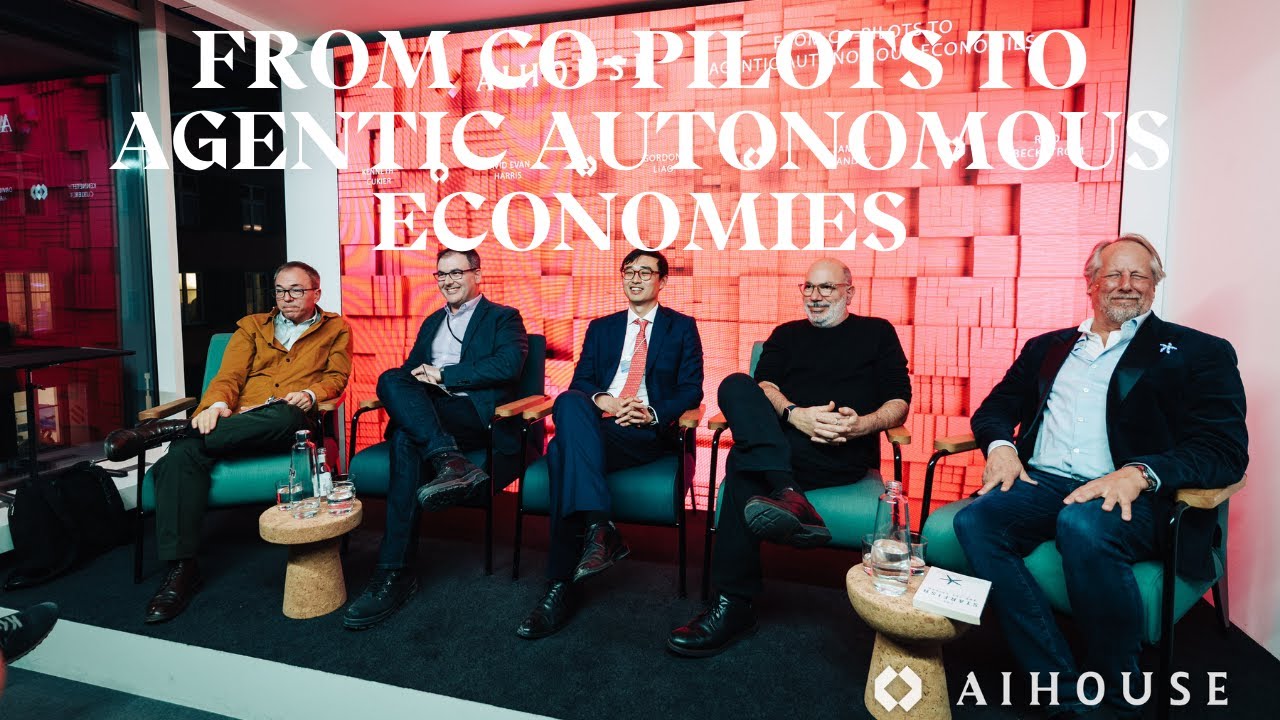
The panel discussion on 'From Co-Pilots to Agentic Autonomous Economies' explored the definition, applications, and future implications of agentic AI. Panelists debated the precise meaning of 'agentic,' with some emphasizing its novelty and others highlighting its roots in established computer science concepts. They discussed current applications like coding agents and trading bots, while also envisioning a future with trillions of agents interacting across various sectors. A key point of contention was the balance between innovation and safety, with panelists expressing differing views on the imminence of superintelligence and the potential for AI to cause harm. The discussion also touched on the economic implications of agentic AI, including the potential for job displacement and increased inequality. Panelists agreed on the need for transparency, identity management, and ethical considerations in agent development. They also acknowledged that current legal and regulatory frameworks are inadequate to address the challenges posed by agentic systems. The discussion highlighted the importance of establishing new standards, protocols, and governance mechanisms to ensure the safe and beneficial development of agentic AI. The panelists also touched upon the potential for blockchain and cryptocurrencies to facilitate agent transactions and the need for a system of value exchange to enable a free market for agentic AI systems. The panel concluded with a poll of the audience, revealing a mixed view on whether agentic economies are a reality or hype, suggesting that it may be both.
Panelists
- Agentic AI is currently a marketing term and overhyped.
- Advocates for AI transparency, including disclosure requirements for AI interactions.
- Worries about the potential for agents to deceive humans.
- Highlights the importance of public policy in addressing the concentration of power in big tech.
- Agents are a spectrum of intelligence and autonomy, with trading bots as an early example.
- Sees coding agents as a common current application.
- Believes blockchain and cryptocurrencies are likely to be adopted by agents for payments and transactions.
- Stresses the need for a system of value exchange to enable a free market for agentic AI systems.
- Agents have a long history in computer science as a design pattern.
- Agents exist across a spectrum, from small autonomous components to chunkier agents representing humans.
- Emphasizes the importance of trust and safety in the development of agentic economies.
- Expresses skepticism about the imminence of superintelligence and focuses on addressing current AI harms like disinformation and bias.
- Highlights the decentralized nature of agentic systems and the importance of protocols and ideology.
- Introduces Beckstrom's Law for valuing networks in the context of agentic economies.
- Emphasizes the potential for agents to self-spawn and reconfigure, leading to rapid evolution and control challenges.
- Points to successful applications of agentic software in cybersecurity and industrial automation.
Main Discussion Points
- Defining agentic AI and differentiating it from traditional AI and software.
- Examples of current and future applications of agents in various sectors.
- The economic implications of agentic economies, including value exchange, job displacement, and potential for inequality.
- The role of blockchain and cryptocurrencies in facilitating agent transactions.
- The challenges of AI safety, control, and liability in agentic systems.
- The importance of transparency, identity management, and ethical considerations in agent development.
Key Insights
✓ Consensus Points
- Agentic AI has the potential to significantly impact various aspects of the economy and society.
- AI safety and ethical considerations are crucial in the development of agentic systems.
- Transparency and identity management are important for building trust and accountability in agent interactions.
- The current legal and regulatory frameworks are inadequate to address the challenges posed by agentic AI.
⚡ Controversial Points
- The definition of agentic AI and whether it warrants a new term.
- The imminence and nature of superintelligence and its potential threat to humanity.
- The extent to which agents should be autonomous versus human-controlled.
- Whether AI models should have legal status or rights.
- The balance between innovation and safety in AI development.
- The role of government regulation in addressing the potential harms of AI.
🔮 Future Outlook
- A future with trillions of active agents interacting with each other and the outside world.
- Increased automation and efficiency in various industries through the use of agents.
- The emergence of new economic models and opportunities based on agent transactions.
- Potential for job displacement and increased inequality due to the widespread adoption of agents.
- The need for new standards, protocols, and governance mechanisms to manage agentic systems.
- Increased focus on AI safety and the development of solutions to mitigate potential harms.
💡 Novel Insights
- The analogy of agents as ants in a network, highlighting their potential for collective action and emergent behavior.
- The application of Beckstrom's Law for valuing networks to agentic economies.
- The idea of a 'sociology of agents' and the need to establish rules and concepts to govern their interactions.
- The concept of agents self-spawning and creating new agents, leading to rapid evolution and control challenges.
- The potential for graph AI and agentic software to revolutionize cybersecurity and other fields.
- The suggestion that faith and religion offer a framework for morality that can inform the development of ethical AI.