Executive Summary
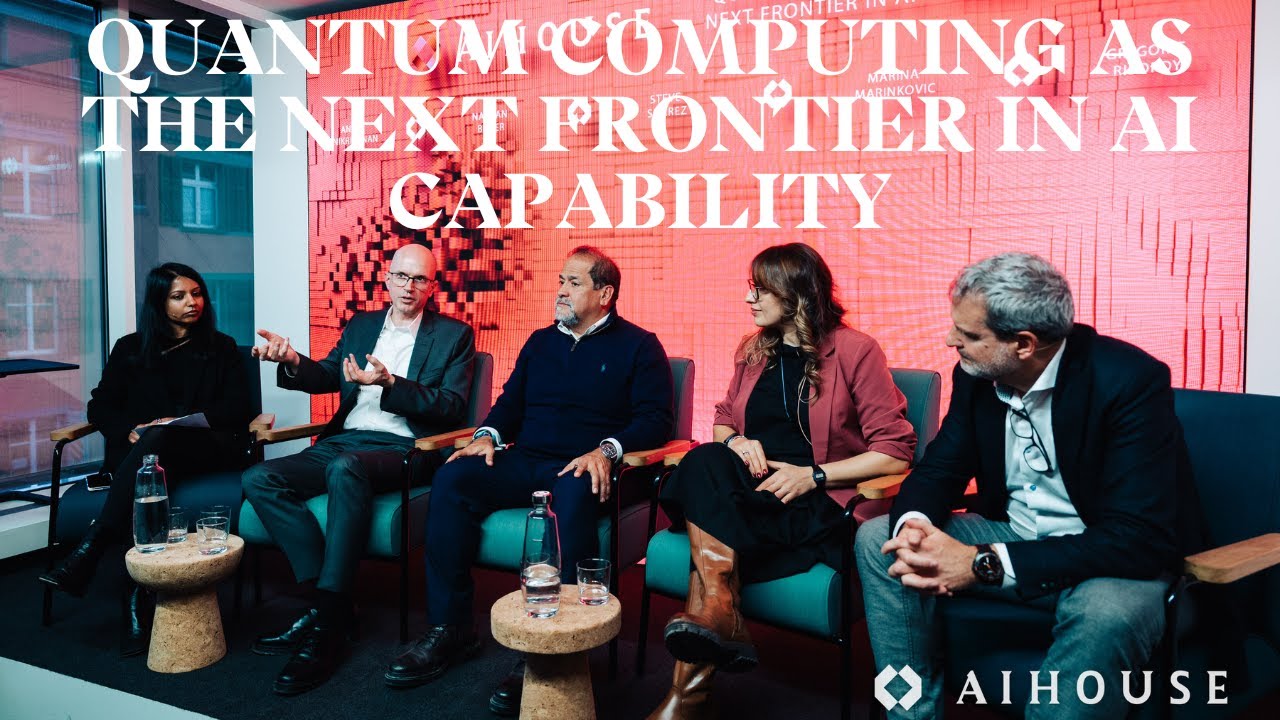
The panel discussion centered on the intersection of quantum computing and artificial intelligence, exploring their distinct capabilities, potential synergies, and the challenges and opportunities they present. Panelists emphasized that while AI has already made a significant impact across various sectors, quantum computing, though still in its early stages, holds immense promise as the next major leap in computing power. A key point of discussion was the complementary nature of these technologies, with AI potentially enhancing quantum experiments and quantum computing providing more accurate training data for AI models. The panel also addressed the looming threat of quantum computers breaking current cryptographic standards, urging companies to begin preparing for quantum-safe security measures now. Panelists agreed that education and workforce development are crucial for the successful adoption of quantum technologies. They highlighted the need for a global approach to training and attracting talent, emphasizing that good ideas can come from anywhere. While acknowledging the hype surrounding quantum computing, the panelists cautioned against complacency, stressing that early adopters who invest in education, talent acquisition, and experimentation will gain a significant competitive advantage. The discussion concluded with a call for a balanced perspective, recognizing that quantum computing will not replace classical computing but will serve as a specialized accelerator for specific problems, working in tandem with AI and other computing technologies to drive innovation across various industries.
Panelists
- Quantum computing poses a threat to current cryptographic security.
- Quantum technologies can be used to secure information in a quantum world through quantum communication.
- AI can be used to develop new cryptanalysis techniques to attack post-quantum cryptography algorithms.
- Companies must start preparing now for quantum-safe security.
- AI hasn't been as successful as classical methods in theoretical particle physics due to 40 years of optimization of classical algorithms.
- AI is making progress in data analysis of particle physics experiments and material science.
- Quantum computing can help study phase diagrams of new materials and interactions of our universe.
- Quantum education and workforce development are crucial for the future.
- AI is used to screen millions of compounds in chemistry, replacing expensive classical computing calculations.
- AI models are limited by the training data from classical computers, which make approximations.
- Quantum computers can provide exact answers for training data, improving the accuracy of AI models.
- Physical and logical qubits need to improve for quantum computing to be more effective.
- Quantum and AI can be used for fraud detection and anomaly detection in finance.
- Companies that act early, educate their staff, and get access to quantum systems will have a great advantage.
- The risk is doing nothing and waiting for quantum to get better.
- Quantum is more than just compute; it includes sensing and communication.
Main Discussion Points
- The differences between AI and quantum computing and their respective strengths.
- Examples of how AI and quantum techniques can be used as complementary approaches in fields like chemistry, physics, finance, and cybersecurity.
- The challenges and bottlenecks in simulating complex systems with quantum computers.
- The importance of preparing for the quantum revolution now, including education and workforce development.
- The risks and opportunities associated with quantum computing, including the threat to cryptography and the potential for new applications.
- The need for a global approach to quantum education and workforce development.
Key Insights
✓ Consensus Points
- The importance of starting to prepare for quantum computing now, even if it is not yet fully mature.
- The need for education and workforce development in quantum technologies.
- The future will likely involve a hybrid approach, with AI and quantum computing working together.
- Quantum computing is more than just computing; it includes sensing, communication, and security.
- Quantum computers will not replace classical computers but will be used as accelerators for specific problems.
⚡ Controversial Points
- The exact timeline for when quantum computers will be powerful enough to break current cryptography, with some panelists emphasizing the need to act now and others suggesting a later timeframe.
- The extent to which technological sovereignty should influence the development and adoption of quantum technologies, with concerns raised about potential slowdowns in progress.
🔮 Future Outlook
- Quantum computers will become more powerful and capable, leading to new applications in various fields.
- AI and quantum computing will increasingly work together in a hybrid approach.
- There will be a significant upgrade in cryptography due to quantum computing.
- The quantum workforce will need to grow to meet the demands of the industry.
- Quantum computing will become more accessible through cloud services and other initiatives.
- Quantum computers will be used to solve very specific problems, working in an ecosystem with HPC and GPUs.
💡 Novel Insights
- The idea of using AI to attack post-quantum cryptography algorithms.
- The concept of 'harvest now, decrypt later' attacks, where data is intercepted and stored until a quantum computer is available to decrypt it.
- The analogy of quantum computing as a marathon, requiring preparation and training.
- The idea that quantum computing is driving innovation in classical computing as well.
- The notion that quantum computing is not just about computing, but also about sensing, communication, and security.