Executive Summary
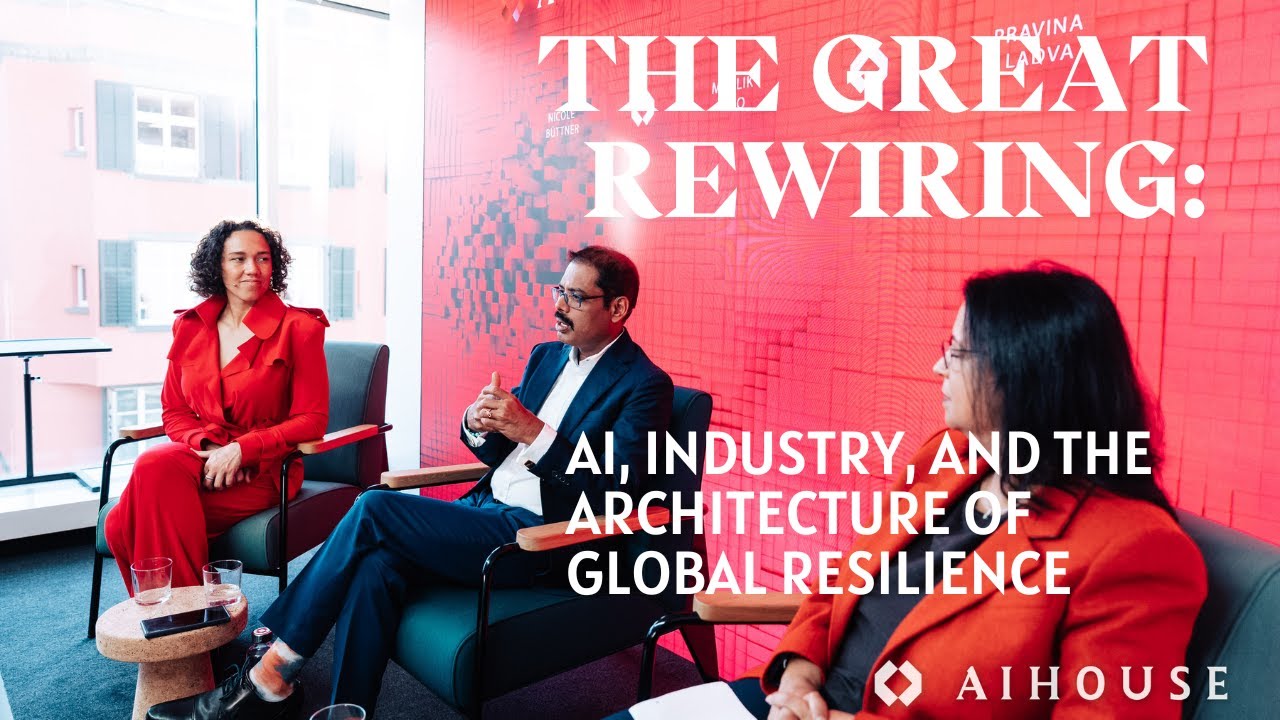
The panel discussion centered on the transformative impact of AI on industry and global resilience. Nicole Büttner framed the conversation around the divergence between AI builders, consumers, and coordinators, emphasizing the need for speed and understanding the changing industrial architectures. Pravina Ladva highlighted the centrality of AI to Swiss Re's strategy, stressing the importance of digital trust, change management, and avoiding disintermediation. She advocated for a balanced approach of top-down tool provision and bottom-up success celebration, emphasizing 'strategic patience' in realizing AI's benefits. Mallik Rao discussed AI's disruptive influence on the telecom industry, emphasizing the need for cultural transformation, caution in critical infrastructure applications, and supply chain resilience. He shared Telefonica's approach to empowering employees through training and experimentation, measuring 'madness' in AI investment. Both panelists agreed on the importance of understanding the business problem before implementing AI solutions and the need for 'bilingualism' - tech people speaking business and business people speaking tech. The discussion also touched on the skills needed for executives to stay competitive, emphasizing agility, cross-functional thinking, and a risk-based approach to innovation. Ultimately, the panel conveyed that resilience in the age of AI is not about stability but about adaptability, early detection, and informed decision-making.
Panelists
- Telecom is a completely distributed, real-time infrastructure where milliseconds count, and trust is paramount.
- AI is disruptive for the telecom industry, requiring a rewiring of wireless networks.
- Investing in people and culture is central to Telefonica's AI strategy, transforming and educating employees.
- Telecom needs to be extremely cautious about AI adoption due to the critical nature of its infrastructure, prioritizing sovereignty, resilience, and redundancy.
- AI and data are central to Swiss Re's strategy, transforming core processes like claims, underwriting, and actuarial work.
- The power shift is about who produces and who consumes AI technology; organizations must avoid disintermediation and protect their IP.
- Digital trust, governance, and security are fundamental to AI adoption.
- Change management is a bigger challenge than technology itself; organizations need to adapt processes and operating models.
Main Discussion Points
- The divergence between those building AI, consuming AI, and coordinating AI complexity.
- The speed of decision cycles in the AI-driven world.
- How AI is changing the role of telecom operators from connectivity providers to intelligence and platform partners.
- The importance of change management and organizational culture in AI adoption.
- Measuring the impact and ROI of AI investments.
- The role of AI in building resilience in a changing geopolitical landscape.
- Skills needed for executives and board members to stay competitive in an AI-driven world.
Key Insights
✓ Consensus Points
- The importance of putting people at the center of AI adoption and focusing on change management.
- The need for a balance between strategic planning and experimentation in AI investments.
- The importance of understanding the business problem or opportunity before implementing AI solutions.
- The need for bilingualism: tech people speaking business and business people speaking tech.
- The importance of agility and the ability to absorb new information.
⚡ Controversial Points
- Mallik Rao's initial statement that every task given to an intern can be automated, which was challenged by an audience member who suggested rewiring those thoughts.
🔮 Future Outlook
- AI will continue to evolve rapidly, requiring continuous engagement and adaptation.
- The benefits of AI adoption will take longer than expected to realize industry-wide, requiring strategic patience.
- The need for federated AI models where intelligence is distributed across multiple areas.
- The importance of supply chain resilience in a changing geopolitical landscape.
💡 Novel Insights
- The idea of strategic patience, emphasizing the need to be patient with AI investments as the benefits will take time to materialize.
- The concept of 'bilingualism' - tech people needing to speak business and business people needing to speak tech.
- Mallik Rao's measurement of 'madness' in AI investment, allocating a small percentage of the budget for experimentation and letting go of governance.
- The idea that compelling events, like the Ukraine war and the energy crisis, can drive AI adoption and innovation.