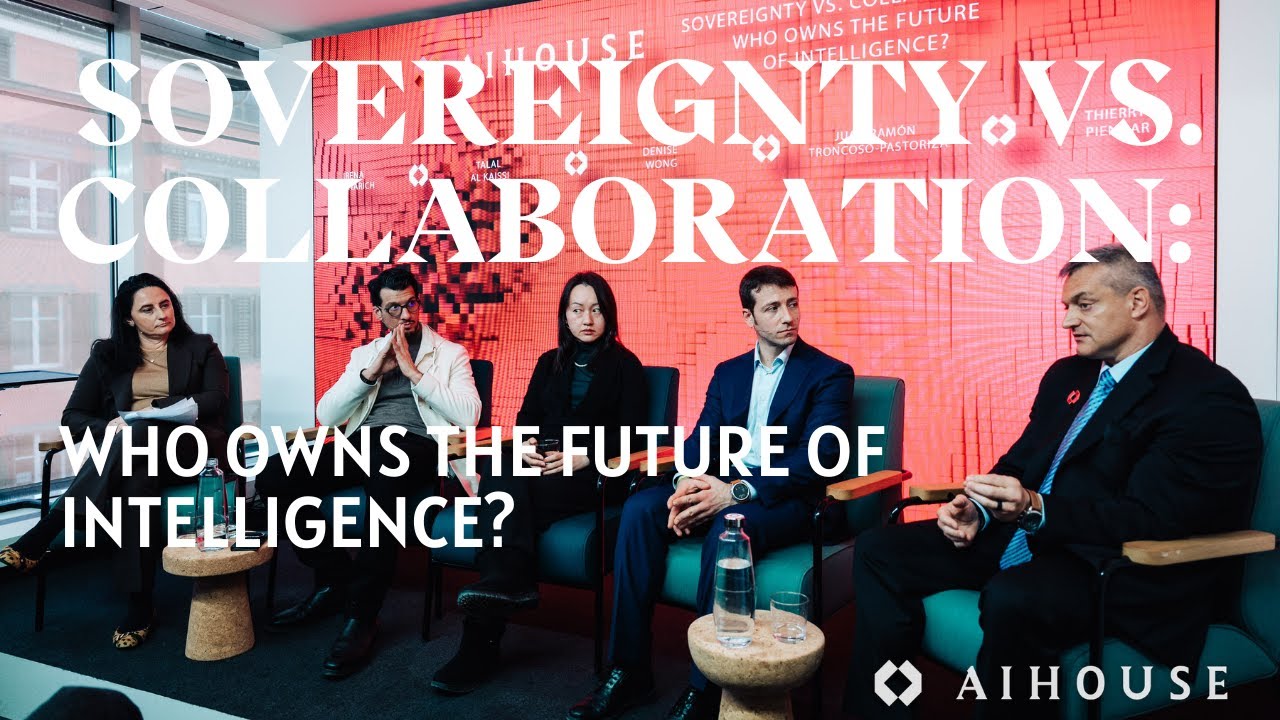
Executive Summary
The panel discussion on AI sovereignty explored the complex interplay between the desire for control and the need for collaboration in the age of artificial intelligence. Panelists agreed that full control of the entire tech stack is unrealistic for most countries, emphasizing the importance of defining sovereignty in the context of national priorities, cultural values, and specific use cases. A key theme was the shift from data sovereignty to a broader understanding encompassing infrastructure, supply chains, and operational control. The discussion highlighted the tension between the need for data localization and the benefits of global data sharing for AI training and innovation, with panelists advocating for privacy-enhancing technologies and federated learning to strike a balance. The panelists also explored the role of regulation, with a consensus emerging around a sector-specific approach that allows for targeted interventions while fostering innovation. International collaboration was deemed essential for developing effective regulatory frameworks and ensuring that AI benefits all of humanity. Novel insights included the concept of an 'intelligence grid' and 'digital embassies' that can extend AI capabilities to countries with limited resources. The discussion concluded with a call for a mindset shift from moving data to moving insights, and a recognition that AI is not just a technology discussion but a geopolitical one, requiring leaders to master both domains to navigate the complex landscape of AI sovereignty.
Panelists
- Full sovereignty over the entire tech stack is not realistic for most countries.
- Sovereignty means preserving a society's way of life, languages, and values in a digital environment.
- Building confidence in AI use is crucial for adoption and economic growth.
- Representation of local culture and values in AI models is important, as demonstrated by Project Sea Lion.
- Data and operational layers are tightly linked and cannot be decoupled.
- Focus should be on moving insights rather than moving data, especially in healthcare.
- Smart combination of federated learning, federated analytics, privacy-enhancing technologies, and differential privacy can minimize risk.
- Risk evaluation depends heavily on the use case; a one-size-fits-all approach is not suitable.
- Full stack sovereignty is likely impossible even for large countries like China and the US.
- Countries need to define their main prerogatives in the multi-layered sovereignty debate, including operational and financial sovereignty.
- Air-gapped or disconnected cloud settings are necessary for highly sensitive data.
- Created a sovereign control platform on top of Microsoft's public cloud with technical and policy controls.
- The strategy has moved from a less opinionated cloud era to more opinionated measures and evaluations of what can be developed on a national level.
- There needs to be a balance between developing strategic autonomy and interacting with the broader world to benefit from innovation.
- AI is no longer just a technology discussion, but a geopolitical and technology discussion.
- Leaders need to master both AI and geopolitical considerations.
Main Discussion Points
- The shift from data sovereignty to infrastructure and supply chain sovereignty.
- The tension between the need for control and the benefits of distributed AI training.
- Defining sovereignty in the context of different national priorities and cultural values.
- The role of data security classifications and risk assessment frameworks.
- The use of privacy-enhancing technologies like federated learning and trusted execution environments.
- The importance of balancing security with the need for data flow and innovation.
- The potential for enterprises to define and implement their own sovereignty strategies.
- The need for international coordination of regulatory frameworks.
- The role of capacity building and investment in AI infrastructure.
Key Insights
✓ Consensus Points
- Full control of the entire tech stack is unrealistic for most countries.
- Sovereignty doesn't necessarily mean the same thing to all stakeholders.
- Risk assessment and data classification are crucial for determining the appropriate level of control.
- A sector-specific approach to regulation is more effective than a one-size-fits-all approach.
- International collaboration is essential for developing effective regulatory frameworks.
⚡ Controversial Points
- Talal Al Kaissi disagreed with Denise Wong's estimate that 95% of countries cannot achieve full stack sovereignty, arguing that it's closer to 100%.
- Implicit tension between the need for data localization and the benefits of global data sharing for AI training and innovation.
🔮 Future Outlook
- Enterprises will increasingly define and implement their own sovereignty strategies.
- AI native software will become more prevalent, optimizing infrastructure and resources.
- AI agentic systems will augment traditional HPC simulation workloads.
- Convergence of HPC, AI, IT services, and security services.
- Increased use of AI agentic systems with reasoning models to enhance traditional HBC simulation workloads.
- The development of specialized language models for specific industries and data sets.
💡 Novel Insights
- The concept of an 'intelligence grid' that can provide AI services to countries without requiring physical data centers.
- The idea of 'digital embassies' that can deliver sovereign AI solutions from one country to another.
- The mindset shift from moving data to moving insights, enabled by federated learning and other privacy-enhancing technologies.
- The importance of AI literacy training for public servants.
- The recognition that AI is not just a technology discussion but a geopolitical one, requiring leaders to master both domains.