Executive Summary
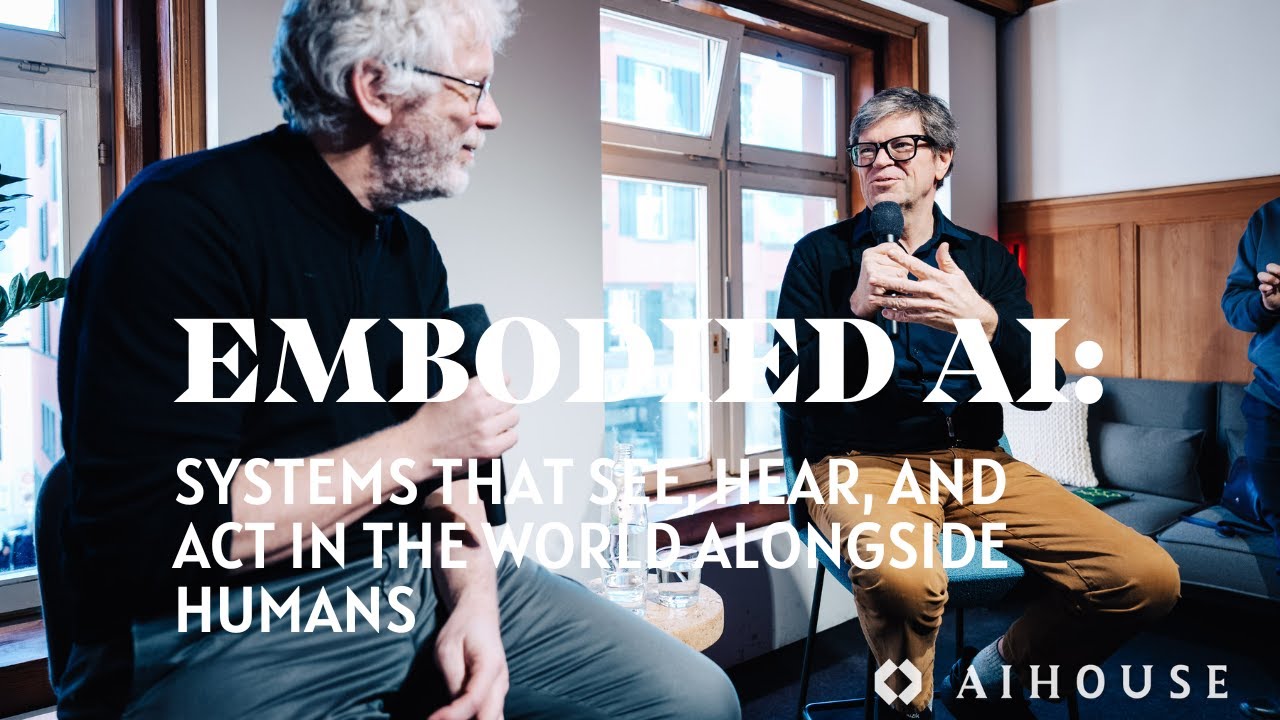
The panel discussion centered on the challenges and opportunities in embodied AI, focusing on the development of AI systems that can perceive, reason, plan, and act in the real world. Yann LeCun argued that current approaches like LLMs, VLMs, and VAS are limited by their reliance on scripted tasks and their inability to handle the complexities of real-world data. He emphasized the importance of world models, which enable AI systems to predict the consequences of their actions and plan effectively. Marc Pollefeys acknowledged the limitations of current approaches but suggested that they still have significant potential for delivering value in industry, particularly for scripted tasks. A key point of contention was the role of generative models, with LeCun strongly dismissing their ability to predict pixel-level details in videos, while Pollefeys suggested that it might be possible in certain scenarios. The panelists agreed on the importance of world models and abstraction for AI systems to understand the world and act effectively. They also discussed the role of different learning paradigms, including self-supervised learning, imitation learning, and reinforcement learning, in building intelligent systems. LeCun presented an analogy of the AI learning process to a cake, with self-supervised learning as the main ingredient, followed by imitation learning and reinforcement learning. He also argued that the main limitation in AI is hardware, specifically the need for more energy-efficient devices that can perform computations in parallel without shuffling data from memory. Looking to the future, LeCun predicted that the next AI revolution will be driven by systems that can predict the consequences of their actions using planning and world models, and he is starting a new company to pursue this vision.
Panelists
- LLMs are successful because language is easy, while the real world presents fundamentally different challenges due to high-dimensional, continuous, and noisy data.
- Current approaches like VLMs and VAS are brittle and limited to scripted tasks, lacking the common sense and planning abilities needed for general intelligence.
- World models are crucial for agentic systems, enabling them to predict the consequences of their actions and plan accordingly.
- Prediction should occur in an abstract representation space, eliminating irrelevant details to enable long-term prediction.
- There is a lot of potential for current VLM and VA technology to deliver value in industry, particularly for scripted tasks.
- Video models can do very nice work in particular when you're given a starting position and you have to predict now I just need to do a relatively simple task.
- It is important to be able to predict throughout the levels and go, yeah, totally.
- Sometimes you can actually go to the pixel level.
Main Discussion Points
- The definition and scope of embodied AI, including both physical robots and AI for understanding and controlling real-world systems.
- The limitations of current AI approaches, particularly LLMs, VLMs, and VAS, in dealing with the complexities of the real world.
- The importance of world models for enabling AI systems to predict the consequences of their actions and plan effectively.
- The role of different learning paradigms, including self-supervised learning, imitation learning, and reinforcement learning, in building intelligent systems.
- The hardware challenges in creating energy-efficient AI systems that can operate in real-time.
- The need for abstraction and hierarchical planning in AI systems to handle the complexity of real-world tasks.
Key Insights
✓ Consensus Points
- LLMs are useful for coding.
- World models are important for AI systems to understand the world and act effectively.
- Abstraction is crucial for intelligence.
- Simulation is a useful tool for training robots and decoupling costs.
⚡ Controversial Points
- LeCun argues that VLMs and VAS are limited to scripted tasks, while Pollefeys believes they have significant potential for delivering value in industry.
- LeCun strongly dismisses the possibility of using generative models to predict pixel-level details in videos, while Pollefeys suggests that it might be possible in certain scenarios.
- LeCun argues that adjusting a world model is self-supervised learning, while Pollefeys suggests it is reinforcement learning.
🔮 Future Outlook
- LeCun predicts that the next AI revolution will be driven by systems that can predict the consequences of their actions using planning and world models.
- LeCun is starting a new company to build AI systems that can understand the physical world, build models, and plan hierarchically.
- The panelists discussed the potential for future AI systems to learn and adapt online, adjusting their behavior based on experience.
💡 Novel Insights
- LeCun's emphasis on the importance of abstract representation spaces for prediction, rather than pixel-level prediction.
- LeCun's analogy of the AI learning process to a cake, with self-supervised learning as the main ingredient, followed by imitation learning and reinforcement learning.
- LeCun's assertion that the main limitation in AI is hardware, specifically the need for more energy-efficient devices that can perform computations in parallel without shuffling data from memory.