Executive Summary
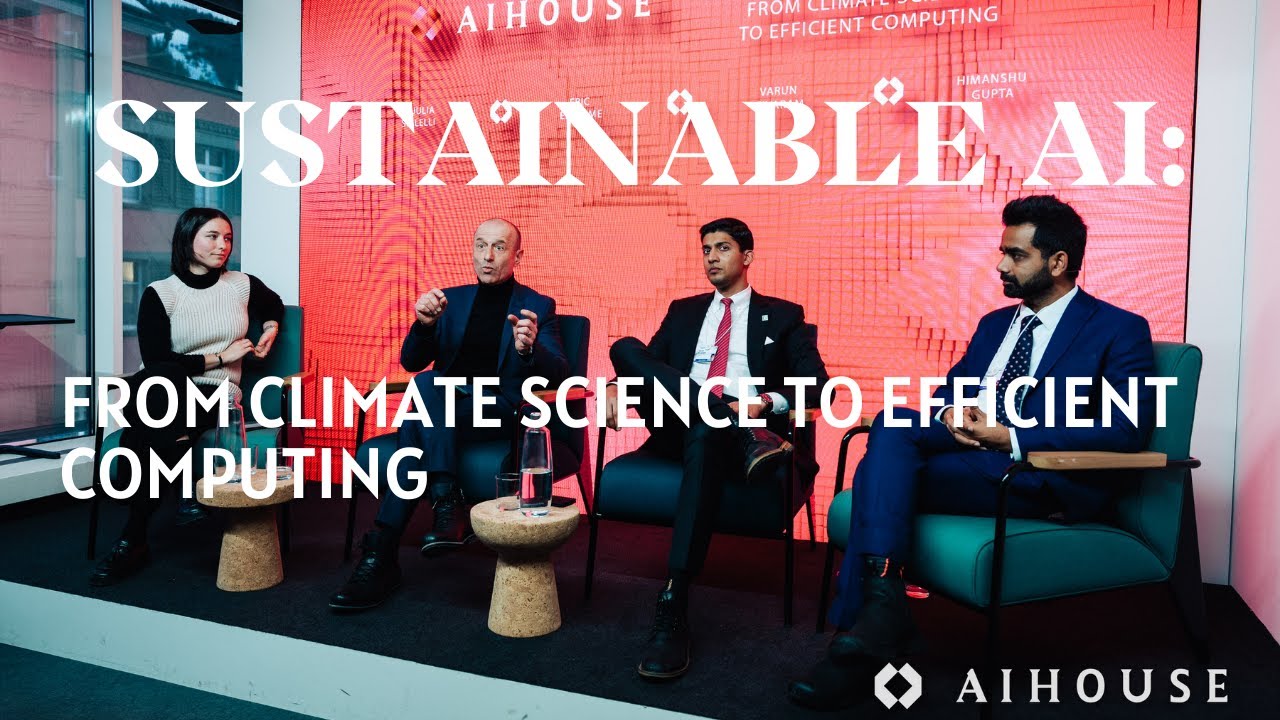
The panel discussion on Sustainable AI at AI House Davos centered on the complex relationship between AI's growing energy demands and its potential to address climate change. Panelists explored the challenges of balancing AI development with sustainability goals, highlighting the need for systemic interventions to ensure a net positive impact. Key discussion points included the inadequacy of current grid capacity, the Jevons paradox, and the importance of building trust in AI predictions. Varun Sivaram emphasized the potential for AI to transform data centers into flexible grid assets, while Himanshu Gupta focused on AI's role in enhancing climate resilience in food systems. Eric Enselme advocated for a holistic approach encompassing efficient design, impactful deployment, and responsible demand shaping. The panelists engaged in a lively debate regarding the alignment of sustainability and competitiveness, the prioritization of resources, and the extent to which market demand should drive AI development. While disagreements arose, there was a consensus on the need for collaboration, transparency, and standardized metrics to measure AI's environmental footprint. The discussion concluded with an optimistic outlook on AI's potential to drive innovation in clean energy technologies and create a more sustainable future, provided that stakeholders work together to steer its development responsibly. The panelists agreed that AI can be a powerful tool for addressing climate change, but its success depends on careful planning, responsible implementation, and a shared commitment to sustainability.
Panelists
- Climate change is most disruptive through increased volatility in food and agriculture, leading to consecutive years of crop losses and farmer bankruptcies.
- AI is a time and effectiveness multiplier for climate change solutions, enabling faster development of climate-resilient seeds by optimizing trial locations.
- Building trust in AI predictions requires transparency about model limitations and educating users on how to act on uncertainty, similar to finance industry risk management.
- Prioritizing societal progress and including people in systems modeling is crucial when considering the impact of AI and resource allocation.
- The world is woefully inadequate in terms of grid capacity to meet the growing demand of AI compute, with the US facing a power bottleneck while China has spare capacity.
- Emerald AI enables data centers to be flexible grid citizens by flexing their power, connecting to grids faster, integrating clean energy sources, and taking advantage of spare capacity.
- Barriers to adoption include the traditional inflexibility of the electric power and data center industries, requiring compromise and new connection methodologies.
- AI can drive the development of next-generation clean technologies and transform data centers into grid assets that integrate clean energy sources, aligning sustainability with competitiveness.
- The net positive AI energy framework focuses on designing for efficiency, deploying for impact, and shaping demand responsibly to ensure AI's total net effect is positive.
- The Jevons paradox (increased use due to cheaper technology) and dark data (unleveraged data) can negate AI's efficiency gains, requiring systemic intervention.
- Measuring AI efficiency credibly requires standard metrics like the sustainable AI quotient (financial, energy, CO2, water) and incentives for highly efficient providers.
- AI is exacerbating water scarcity, so the focus should be on impact first, and AI should be used to improve standards of living and decarbonize the world.
Main Discussion Points
- The paradoxical nature of AI as both a major energy consumer and a potential solution for climate change.
- The current state of grid capacity versus the growing energy demands of AI compute, and the impact on energy costs.
- How AI can be used to reduce and mitigate climate change, particularly in food systems and clean energy.
- Barriers to adoption of sustainable AI practices, including industry inflexibility and the need for policy changes.
- The Jevons paradox and dark data as potential obstacles to realizing AI's efficiency gains.
- Building trust in AI predictions and bridging the gap between probabilistic climate risks and concrete business decisions.
- The global race for AI supremacy and how to create a cross-sector, cross-country vision where sustainable AI is a competitive requirement.
Key Insights
✓ Consensus Points
- AI has the potential to be a major breakthrough in addressing climate change and other complex global challenges.
- Systemic intervention is needed to ensure that the overall net effect of AI is positive, considering energy consumption, CO2 emissions, water usage, and community impact.
- Measuring and educating stakeholders about the true cost and footprint of AI consumption is crucial for driving responsible AI development.
- Collaboration and dialogue are essential for creating a common understanding of the challenges and opportunities presented by AI.
⚡ Controversial Points
- Whether sustainability and competitiveness are inherently aligned, with some arguing that they are often in tension, especially for developing countries.
- The extent to which AI should be allowed to develop freely based on market demand, versus the need for prioritizing resource allocation and societal progress.
- The role of robots in performing household chores, with disagreement on whether this is a worthwhile application of AI given potential externalities.
- The degree to which AI can solve climate change given budget deficits and shifting priorities towards AI and defense.
🔮 Future Outlook
- Data centers will consume 20% of global energy by 2030-2035.
- AI will drive the development of next-generation clean technologies, such as advanced solar materials, battery materials, and nuclear fusion.
- AI data centers will become grid assets, actively managing their power consumption to integrate clean energy sources and strengthen grid resilience.
- The network of data centers can act as a parallel and complementary grid to the current electricity grid, enabling the movement of computations to areas with the lowest marginal cost of energy or highest availability of clean energy.
💡 Novel Insights
- Framing climate change as a problem of increased volatility rather than long-term temperature increases to resonate with businesses and farmers.
- The concept of AI data centers becoming 'grid citizens' that actively support grid stability and integrate renewable energy sources.
- Using AI to cut renewable curtailment by more than 20% by better matching demand and supply.
- The idea of a 'sustainable AI quotient' that blends financial, energy consumption, CO2 emission, and water usage metrics to measure AI efficiency.