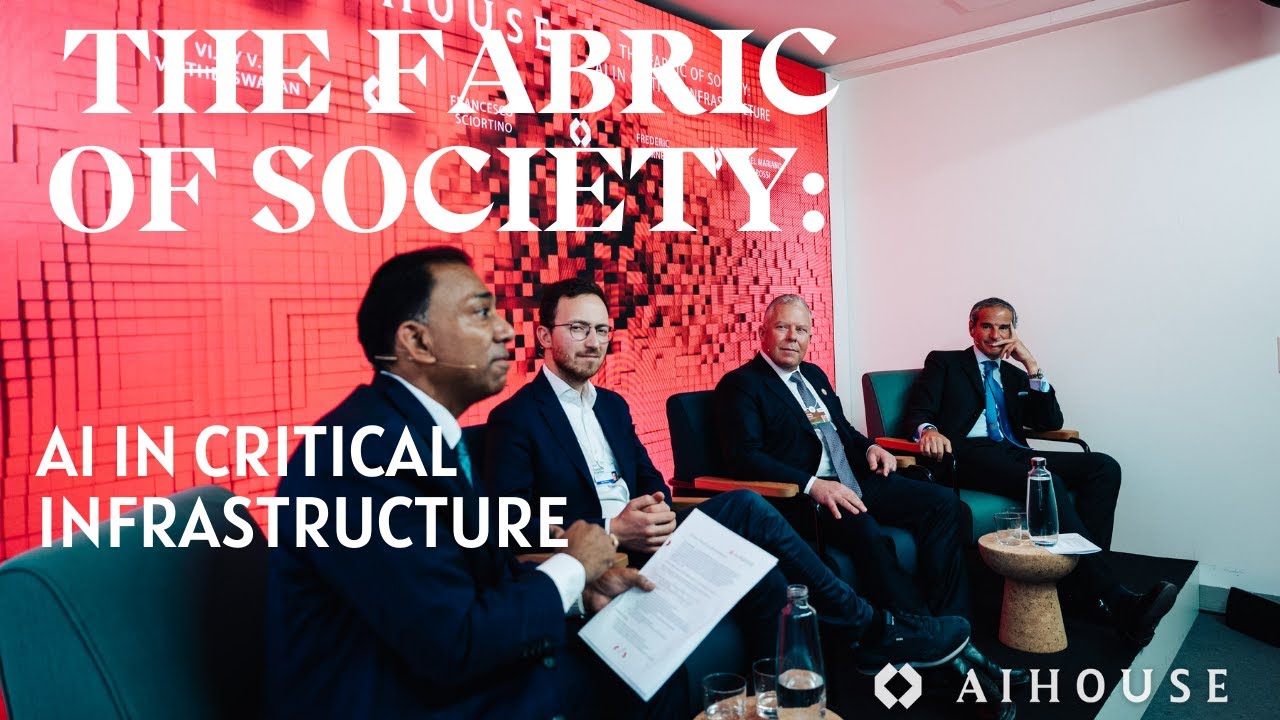
Executive Summary
The panel discussion centered on the intersection of AI and critical infrastructure, with a particular focus on energy. Panelists explored the immense energy demands of AI and the potential of nuclear energy, especially SMRs and fusion, to meet these needs. They highlighted the role of big tech companies in funding clean energy innovation and the importance of public-private partnerships. A key debate revolved around the governance of AI, with differing views on the applicability of nuclear governance models. The discussion also touched on the potential of space computing and edge AI for Earth observation and disaster management. Panelists generally agreed that AI has the potential to accelerate innovation and improve efficiency across various sectors, but also acknowledged the challenges of ensuring equitable access and responsible deployment. The future outlook included expectations for SMR deployment within five years, a potential leapfrogging in clean energy technologies, and the increasing role of AI in driving demand for reliable, clean power sources. The panel concluded that while AI presents significant opportunities, its successful integration into critical infrastructure requires careful consideration of governance, security, and equitable access.
Panelists
- Fusion is a physical phenomenon, not just a technology.
- Stellarators, a type of fusion reactor, are simulation-enabled and benefit greatly from advancements in computation and AI.
- AI can accelerate the design and iteration process for fusion reactors by simplifying the integration of various complex systems.
- Believes that AI's biggest impact will be in infrastructure, licensing, deployment, manufacturing, and quality control for fusion projects.
- AI for Good aims to unlock AI's potential to serve humanity by addressing global challenges.
- It's crucial to ensure AI applications work equitably across different demographics and resource settings.
- AI has a dual nature; just because it can do something doesn't mean it should.
- Space computing, using AI on satellites, can significantly improve real-time Earth observation for climate modeling and disaster management.
- Nuclear energy is indispensable for sustaining the energy demands of AI development.
- Big tech companies are increasingly investing in nuclear energy, particularly SMRs, to secure reliable and CO2-free power.
- The AI-nuclear relationship is creating a demand-driven market for nuclear power.
- The key challenge is speeding up the deployment of SMRs to meet the growing energy needs of the AI industry.
Main Discussion Points
- The increasing energy demands of AI and the need for reliable, clean energy sources.
- The potential of nuclear energy, particularly SMRs and fusion, to meet the energy needs of AI.
- The role of big tech companies in funding and driving innovation in clean energy technologies.
- The challenges and opportunities associated with deploying AI in critical infrastructure.
- The importance of governance and accountability in AI development and deployment.
- The potential of space computing and edge AI to improve Earth observation and disaster management.
- The need for diverse and distributed AI development to avoid over-reliance on a few suppliers.
Key Insights
✓ Consensus Points
- AI has enormous potential for good, particularly in sustainability and other applications.
- The energy demands of AI are insatiable and require diverse clean energy solutions.
- AI can accelerate innovation and improve efficiency in various sectors, including energy.
- Public-private partnerships are crucial for advancing fusion energy development.
⚡ Controversial Points
- The applicability of nuclear governance models to AI governance.
- The timeline for the widespread deployment of SMRs.
- Whether AI will ultimately enhance or diminish energy security.
🔮 Future Outlook
- SMRs are expected to be rolled out in the market within 5 years or less.
- Potential for a leapfrogging in energy towards cleaner and more innovative alternatives driven by AI's energy demands.
- AI is acting as an accelerant in deep tech, potentially making breakthroughs come sooner than expected.
- Expectation of increased nuclear capacity by 2050, although potentially not at the level needed to meet all demands.
- Space computing and edge AI will enable near real-time Earth observation for disaster preparedness and climate modeling.
💡 Novel Insights
- The concept of 'atoms for algorithms,' highlighting the relationship between nuclear energy and AI.
- The idea of big tech companies becoming 'rich green uncles' by funding innovative clean energy projects.
- The argument that space-based data centers could be more energy-efficient and faster due to solar power and laser communication.
- The observation that AI is driving demand for nuclear energy, creating a market-driven impetus for the nuclear industry to deliver.
- The point that AI's impact on infrastructure, licensing, deployment, manufacturing, and quality control is often overlooked but crucial for scaling deep tech.